SCW17/paper-05 Chile HCR proposals

Harvest control rules proposed by the Chilean delegation

Published

June 8, 2026

SPRFMO

South Pacific Regional Fisheries Management Organisation
Jack Mackerel Working Group
SCW17/paper-05 Chile HCR proposals

1 Document Status and Traceability

This page is an SCW17 Quarto conversion of the Word document supplied by the Chilean delegation. The content below preserves the supplied text and embedded figures, with only formatting changes needed to publish it in the SCW17 website structure.

Item Description
SCW17 identifier SCW17/paper-05
SCW17 source file doc/SCW17-Paper-05-Chile-HCR-Proposals.qmd
Original Word document HCR_Chile_08-06-26.docx
Supplied Word filename HCR_Chile (08-06-26).docx
Conversion note Embedded figures were extracted from the Word document and retained as PNG images.
SCW17 role Chilean delegation contribution describing proposed harvest control rules for review and testing.

No benchmark results, operating-model assumptions, management-procedure definitions, performance metric definitions, or reference points were changed by this conversion.

2 Harvest Control Rules Proposed by the Chilean Delegation

Based on the results of the FIPA 2024-27 project, “Design and Implementation of Management Strategies Using the OpenMSE Platform in the Jack Mackerel Fishery”, the Chilean delegation is interested in testing the following Harvest Control Rules (HCRs), which were developed jointly with stakeholders from the jack mackerel fishery, particularly the Jack Mackerel Management Committee.

3 Model-Based Harvest Control Rules

Two HCRs were considered, both expressed as functions of relative biomass and relative catch, as described below:

3.1 HCR2: Ramp-Type Rule

HCR2 is a ramp-type rule (Figure 1) with a catch stability constraint of +20%/-15% (increase/decrease), a minimum catch of 270,000 tonnes, and a target catch level (TACref) of 1,500,000 tonnes.
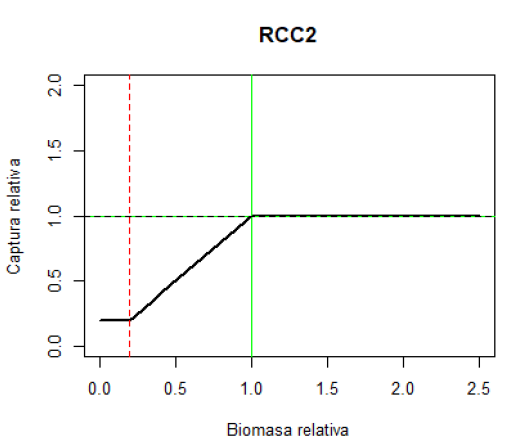
Graphical representation of the ramp-type harvest control rule. The green line indicates the target biomass and the red line indicates the biomass limit threshold.

Figure 1: Graphical representation of the ramp-type Harvest Control Rule (HCR). The green line indicates the target biomass, while the red line represents the biomass limit threshold (Blim).

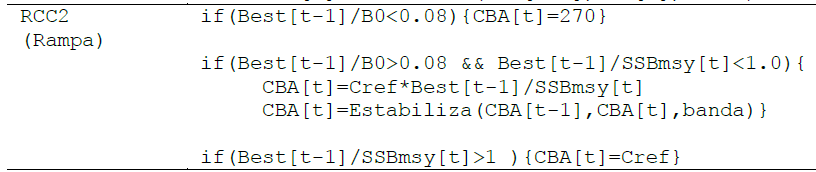
Screenshot of R code used for implementing the ramp-type harvest control rule.

Table 1: R code used for implementing the ramp-type Harvest Control Rule (HCR). The function Catch() returns two estimates of the Biological Acceptable Catch (CBA also TAC): one based on FMSY and the other based on the current fishing mortality (Fcurrent). The function Stabilize() adjusts the BAC according to the catch stability band. Cref corresponds to the MSY value.

3.2 HCR4: Double-Potential Rule

HCR4 is a double-potential rule (Figure 2) with a catch stability constraint of +20%/-15% (increase/decrease), a minimum catch of 270,000 tonnes, and a target catch level (TACref) of 1,500,000 tonnes.
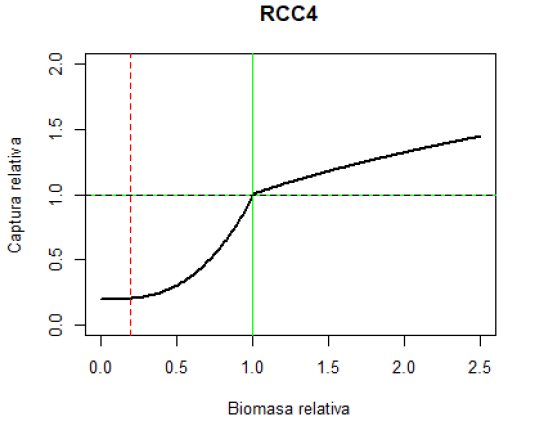

Graphical representation of the double-potential harvest control rule. The green line indicates the target biomass and the red line indicates the biomass limit threshold.

Figure 2: Graphical representation of the double-potential Harvest Control Rule (HCR). The green line indicates the target biomass, while the red line represents the biomass limit threshold (Blim).

Screenshot of R code used for implementing the double-potential harvest control rule.

Table 2: R code used for implementing the double-potential Harvest Control Rule (HCR). The function Catch() returns two estimates of the Biological Acceptable Catch (CBA also TAC): one based on FMSY and the other based on the current fishing mortality (Fcurrent). The function Stabilize() adjusts the BAC according to the catch stability band. Cref corresponds to the MSY value.

4 Empirical Harvest Control Rules

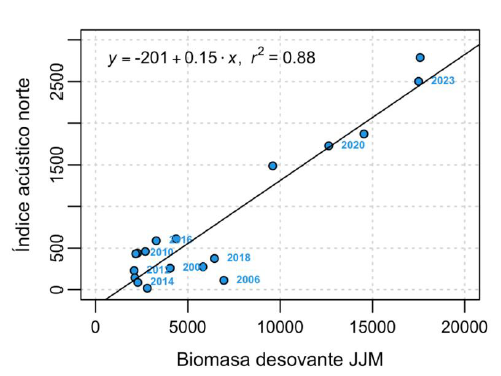
Two empirical HCRs were considered, based on the relationship between spawning biomass estimated by the Joint Jack Mackerel Model (JJM) and the acoustic abundance index obtained from the hydroacoustic survey conducted in Northern Chile (Arica and Parinacota, Tarapacá, and Antofagasta Regions) (Figure 5):

4.1 HCR2: Ramp-Type Rule

HCR2 is a ramp-type rule (Figure 3) with two alternative reference catch levels (Cref) of 1.5 and 2.0 million tonnes, and a minimum catch of 270,000 tonnes.
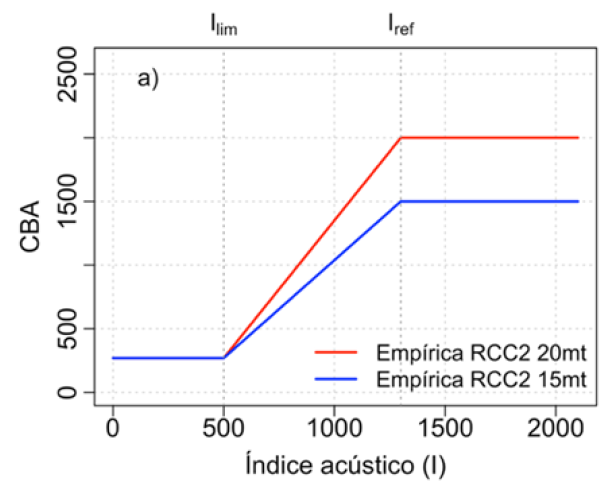
Relationship between biological acceptable catch and the Northern Chile acoustic survey abundance index under a ramp-type harvest control rule for two reference catch levels.

Figure 3. Relationship between the Biological Acceptable Catch (CBA also TAC) and the abundance index derived from the Northern Chile acoustic survey under a ramp-type HCR, for two reference catch levels (Cref) of 1.5 and 2.0 million tonnes. The reference index (Iref) was set at 1.3 million tonnes and the limit index (Ilim) at 500 thousand tonnes.

4.2 HCR4: Double-Potential Rule

HCR4 is a double-potential rule (Figure 4) with two alternative reference catch levels (Cref) of 1.5 and 2.0 million tonnes, and a minimum catch of 270,000 tonnes.
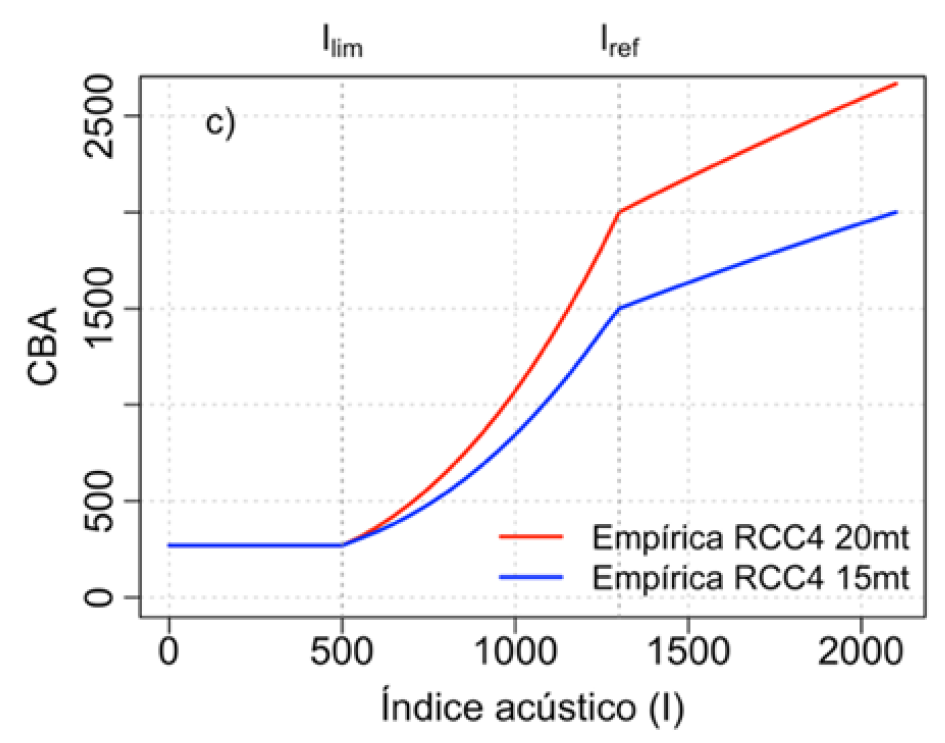
Relationship between biological acceptable catch and the Northern Chile acoustic survey abundance index under a double-potential harvest control rule for two reference catch levels.

Figure 4. Relationship between the Biological Acceptable Catch (CBA also TAC) and the abundance index derived from the Northern Chile acoustic survey under a double-potential HCR, for two reference catch levels (Cref) of 1.5 and 2.0 million tonnes. The reference index (Iref) was set at 1.3 million tonnes and the limit index (Ilim) at 500 thousand tonnes.

Relationship between spawning biomass estimated by JJM and biomass estimated from the Northern Chile acoustic survey from 2000 to 2024.

Figure 5: Relationship between spawning biomass estimated by the stock assessment model (JJM) and biomass estimated from the Northern Chile acoustic survey (2000–2024). The figure shows the linear relationship between both variables and the corresponding goodness-of-fit.