
| model | stock | F35_est | F_at_SPR35_profile | Fmsy | SBF35 | yield_at_SPR35 | yield_at_Fmsy | SPR_at_Fmsy | recruitment_at_SPR35 |
|---|---|---|---|---|---|---|---|---|---|
| h1_0.16ls | 1 | 0.5551 | 0.5551 | 0.3582 | 4182.026 | 1035.46 | 1066.07 | 0.4294 | 7478.033 |
Consideration of reference points used for SPRFMO Jack mackerel management
SPRFMO
South Pacific Regional Fisheries Management Organisation
Jack Mackerel Working Group
SCW17/Paper-02
Consideration of reference points used for SPRFMO Jack mackerel management
Rendered 19 June 2026, 11:01 CEST
Summary
Based on the outcomes of the SCW16 benchmark workshop, the framework for developing and conditioning operating models depends partly on assumptions used for the stock-recruitment relationship (SRR). Here we explore those assumptions using four productivity cases and evaluate the potential for using proxy reference points, including spawning-biomass per-recruit (SPR) quantities that are commonly used worldwide.
The productivity grid now uses four explicit h1_0.16 runs with ll, ls, hl, and hs productivity variants. The matching h2_0.16 two-stock runs are summarized separately using the latest reruns, including the revised h2_0.16ll and h2_0.16ls configurations. Across the primary h1_0.16 runs, F_{MSY} spans 0.358 to 1.108, while F_{35\%} spans only 0.555 to 0.56.
The contrast is useful for management strategy evaluation (MSE). MSY-based reference points are sensitive to SRR assumptions and therefore to operating-model productivity choices. SPR-based reference points are not free of biological or selectivity assumptions, but they are free of SRR assumptions. Dynamic Bzero and Majuro-style stock-status plots provide an additional way to communicate current stock status without dividing biomass by an estimated B_{MSY} that changes across productivity cases.
1 Introduction
SPRFMO jack mackerel management currently relies on reference points derived from the Joint Jack Mackerel Model (JJM). The technical details of the assessment model, reference-point calculations, and data treatment are documented in the SC13 technical annex and in SCW16 working papers (SPRFMO Jack Mackerel Working Group, 2026a; SPRFMO Scientific Committee, 2025). The present paper is narrower. It focuses on how candidate reference points behave when the same model structure is evaluated under different productivity assumptions.
The issue matters because the MSE operating-model grid must represent uncertainty in the stock-recruitment relationship while keeping management quantities interpretable. Dynamic B_{MSY} and F_{MSY} can be suitable for annual assessment advice, but they can complicate MSE interpretation if reference points move because of terminal-year selectivity, weights-at-age, or assumed productivity rather than because of a change in management performance. This concern was also raised in JMWG discussions about fixing reference points for projections and MSE simulations (SPRFMO Jack Mackerel Working Group, 2026b).
This paper therefore compares MSY-based quantities with SPR-based proxies and depletion measures based on dynamic Bzero. It is not intended to replace the full technical documentation. Instead, it identifies a compact set of diagnostics that the working group can use when choosing reference-point conventions for the MSE workshop.
2 Methods
Technical details of the JJM, likelihood components, biological inputs, and assessment diagnostics are described in the SC13 and SCW16 reports (SPRFMO Jack Mackerel Working Group, 2026a; SPRFMO Scientific Committee, 2025). The analyses here use model outputs already available from the 2026 benchmark-preparation runs and focus on derived quantities relevant to reference-point discussion.
2.1 Productivity Cases
The primary one-stock productivity grid uses the h1_0.16.ctl control-file family and its explicit productivity variants. In this paper, “low productivity” refers to steepness h = 0.65 and “high productivity” refers to steepness h = 0.85. The updated short SRR fitting period uses 2001-2015 and the long SRR fitting period uses 1970-2022. The four h1_0.16 runs are:
h1_0.16ll: low steepness and long SRR fitting period;h1_0.16ls: low steepness and short SRR fitting period;h1_0.16hl: high steepness and long SRR fitting period;h1_0.16hs: high steepness and short SRR fitting period.
For each run, the yield profile was read from the .yld output and the reported standard-deviation terms were read from the .std output. The reported F_{MSY}, B_{MSY}, current ratios, profile maximum, and F_{35\%} were then compiled for comparison.
The same productivity suffixes are also summarized for the matching two-stock h2_0.16 runs: h2_0.16ll, h2_0.16ls, h2_0.16hl, and h2_0.16hs. The h2 runs retain the Stock 1 long and short SRR periods used in the one-stock productivity grid, while the Stock 2 SRR period is read directly from the current control files and is common across the four h2 productivity cases. This common Stock 2 period is consistent with the SCW17/Paper-01a finding that additional FarNorth selectivity flexibility changed fitted dynamics mainly through penalty terms rather than improving the direct length-frequency or CPUE fits. For Stock 2, the common period was used to stabilize estimates and results because the available data did not support more detailed productivity estimates. For these h2 runs, stock-specific MSY terms are read by occurrence in the .std file, and stock-specific F_{35\%} values are read from the corresponding _1_R.rep and _2_R.rep files.
2.2 Dynamic Bzero
Dynamic Bzero is computed here only for spawning biomass. The model output contains a fished spawning-biomass time series (SSB) and a counterfactual no-fishing spawning-biomass time series (SSB_Nofishing). The no-fishing series is interpreted as annual dynamic Bzero because it carries the same biological schedules and recruitment history through the population dynamics with fishing mortality removed. Annual depletion is then calculated as:
D_t = \frac{SSB_t}{SSB_{F=0,t}}.
The derived ratio is compared with the reported model output SSB_NoFishR. This comparison checks that the displayed dynamic-Bzero depletion is consistent with the model’s own reported ratio.
2.3 SPR Reference Points
SPR rates are calculated from the equilibrium F profile by finding the fishing mortality that leaves a specified fraction of unfished spawning biomass per recruit. For F_{35\%}, the profile is interpolated to the F value where SPR equals 0.35. This calculation depends on maturity, growth, natural mortality, selectivity, and the relative fishing-mortality pattern among fisheries. It does not depend on the SRR, steepness, unfished recruitment, or the recruitment time-series window. For this reason, SPR-based proxies are useful for comparison with F_{MSY} when the working group wants a reference point that is less sensitive to productivity assumptions.
Fishery-specific F contributions are calculated using end-year mean F by fishery. The ratios are used only to describe the composition of the aggregate F reference point, not to estimate a separate reference point for each fishery.
2.4 Stock-Status Displays
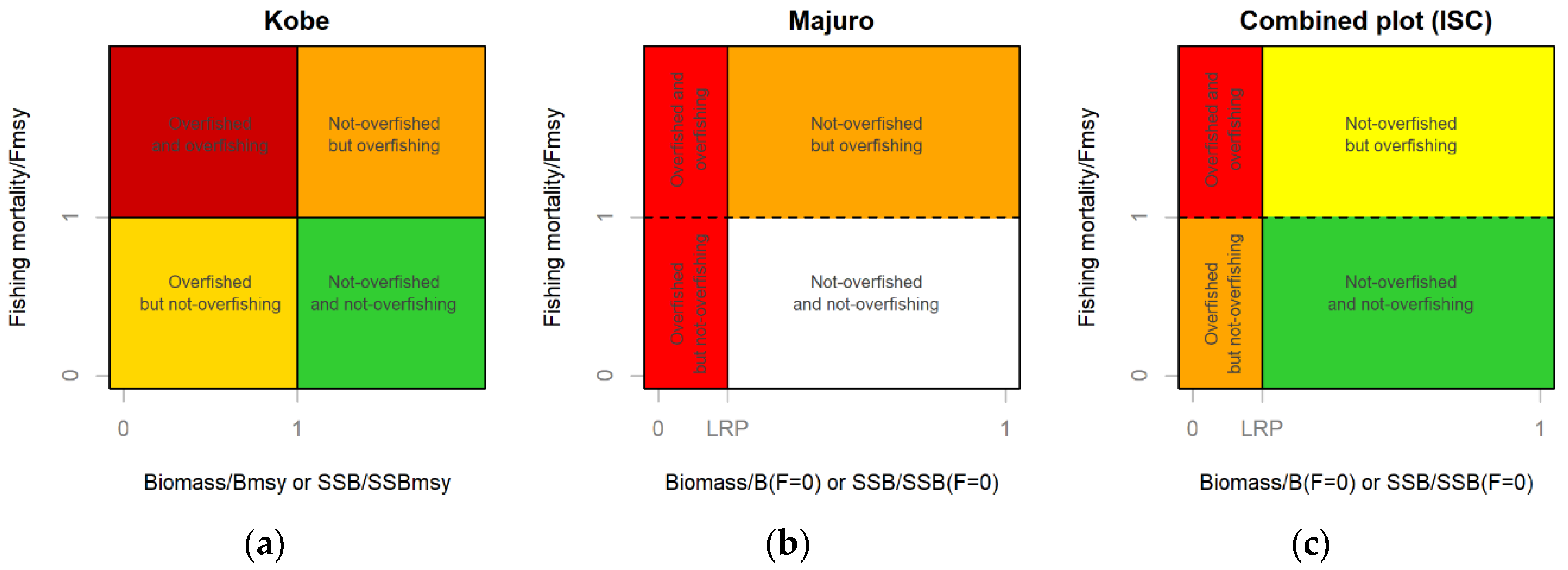
Three stock-status display conventions are relevant. A Kobe plot uses B/B_{MSY} or SSB/SSB_{MSY} on the biomass axis and F/F_{MSY} on the fishing-mortality axis. A Majuro plot keeps F/F_{MSY} on the fishing-mortality axis but replaces the biomass axis with depletion relative to unfished biomass, B/B_{F=0} or SSB/SSB_{F=0}. A combined plot overlays a limit-reference-point threshold on the unfished-biomass scale and uses color categories to distinguish low-biomass and high-fishing-mortality combinations (Merino et al., 2020).
The Majuro plot in this paper uses SSB/SSB_{F=0} from SSB_NoFishR and annual aggregate F divided by each run’s F_{MSY}. The vertical line at 0.2 is shown only as an orienting convention from WCPFC-style tuna displays. It is not proposed here as a jack mackerel limit reference point.
3 Results
3.1 Productivity Estimates
The F profile from h1_0.16ls provides the starting point for comparing MSY-based and SPR-based reference points. In Figure 1, F_{35\%} is marked against the same profile as F_{MSY}. The two values are close only under some productivity assumptions. Across all four runs, F_{35\%} is much more stable than F_{MSY} because it does not use the SRR.


| fishery | end_year | mean_f | max_selectivity_scaled_f | f_ratio | F35_est_contribution | F_at_SPR35_profile_contribution | Fmsy_contribution |
|---|---|---|---|---|---|---|---|
| N_Chile | 2025 | 0.0258 | 0.0512 | 0.0301 | 0.0167 | 0.0167 | 0.0108 |
| SC_Chile_PS | 2025 | 0.8056 | 2.6450 | 0.9397 | 0.5217 | 0.5217 | 0.3366 |
| FarNorth | 2025 | 0.0214 | 0.0445 | 0.0249 | 0.0138 | 0.0138 | 0.0089 |
| Offshore_Trawl | 2025 | 0.0045 | 0.0086 | 0.0052 | 0.0029 | 0.0029 | 0.0019 |
The productivity sensitivity runs span F_{MSY} values from 0.358 to 1.108. The low-steepness cases define the lower end of the range, while the high-steepness cases shift the F-profile peak to substantially higher F values. Changing from the short to the long stock-recruit fitting period has a smaller effect within each steepness assumption than changing steepness itself.
| model | scenario | steepness | sr_years | Fmsy | Fmsy_se | F35_est | F_at_SPR35_profile | Fcur_Fmsy | Bmsy | Bmsy_se | Bcur_Bmsy | profile_Fmsy | MSY | SPR_at_profile_Fmsy |
|---|---|---|---|---|---|---|---|---|---|---|---|---|---|---|
| h1_0.16ls | Low steepness, short SR | 0.65 | 2001-2015 | 0.35816 | 0.02959 | 0.55511 | 0.55511 | 2.39360 | 5723.2 | 1458.80 | 1.21870 | 0.356 | 1066.070 | 0.43053 |
| h1_0.16ll | Low steepness, long SR | 0.65 | 1970-2022 | 0.35848 | 0.02941 | 0.55534 | 0.55534 | 2.41170 | 9580.9 | 1245.00 | 0.71993 | 0.358 | 1784.950 | 0.42953 |
| h1_0.16hs | High steepness, short SR | 0.85 | 2001-2015 | 1.09760 | 0.15156 | 0.55630 | 0.55630 | 0.78243 | 2582.8 | 469.33 | 2.70020 | 1.000 | 998.614 | 0.25944 |
| h1_0.16hl | High steepness, long SR | 0.85 | 1970-2022 | 1.10840 | 0.15256 | 0.56022 | 0.56022 | 0.78111 | 4621.4 | 467.03 | 1.51630 | 1.000 | 1788.320 | 0.26056 |

F35% is comparatively stable across these runs, ranging from 0.555 to 0.56. Under low steepness, F35% sits above F_{MSY}, so it would imply a more aggressive F than the production-based MSY estimate. Under high steepness, F_{MSY} is well above F35%, so F35% becomes the more conservative reference point.

3.2 Two-stock hypotheses
The h2_0.16 run set applies the same productivity suffixes to the two-stock model, but the current control files are stock-specific in the SRR periods. Stock 1 uses 1970-2022 in the long-period cases and 2001-2015 in the short-period cases. Stock 2 uses the same 1970-2016 SRR period in all four h2 productivity cases to stabilize estimates and results, reflecting the Paper-01a diagnostics and the limited data available for more detailed Stock 2 productivity estimates. The h2 reference-point quantities shown here use reruns without a command-line -msy_sel override, so the model default MSY selectivity averaging window is used. These reruns also use the revised h2 recruitment-variability setting, with the Stock 2 sigma_R entry increased from 0.6 to 0.9. Because h2 reports stock-specific reference-point quantities, Stock 1 and Stock 2 (Peruvian zone) are shown separately below rather than mixed in the same table and figure.
Stock 1
| model | scenario | steepness | sr_years | Fmsy | Fmsy_se | F35_est | Fcur_Fmsy | Bmsy | Bmsy_se | Bcur_Bmsy |
|---|---|---|---|---|---|---|---|---|---|---|
| h2_0.16ll | Low steepness, long SR | 0.65 | 1970-2022 | 0.34910 | 0.02878 | 0.52914 | 2.2717 | 8747.30 | 1154.40 | 0.9461 |
| h2_0.16ls | Low steepness, short SR | 0.65 | 2001-2015 | 0.34753 | 0.02910 | 0.52547 | 2.2313 | 5075.50 | 1328.60 | 1.6581 |
| h2_0.16hl | High steepness, long SR | 0.85 | 1970-2022 | 1.18430 | 0.17104 | 0.53748 | 0.6763 | 4078.00 | 420.55 | 2.0698 |
| h2_0.16hs | High steepness, short SR | 0.85 | 2001-2015 | 1.15800 | 0.16961 | 0.52735 | 0.6718 | 2205.30 | 408.92 | 3.8174 |


Stock 2 (Peruvian zone)
| model | scenario | steepness | sr_years | Fmsy | Fmsy_se | F35_est | Fcur_Fmsy | Bmsy | Bmsy_se | Bcur_Bmsy |
|---|---|---|---|---|---|---|---|---|---|---|
| h2_0.16ll | Low steepness, long SR | 0.65 | 1970-2016 | 0.09513 | 0.00169 | 0.10651 | 0.3611 | 1211.10 | 247.90 | 3.3384 |
| h2_0.16ls | Low steepness, short SR | 0.65 | 1970-2016 | 0.09513 | 0.00169 | 0.10651 | 0.3611 | 1211.10 | 247.90 | 3.3384 |
| h2_0.16hl | High steepness, long SR | 0.85 | 1970-2016 | 0.14466 | 0.00275 | 0.10680 | 0.2364 | 804.62 | 158.12 | 5.0604 |
| h2_0.16hs | High steepness, short SR | 0.85 | 1970-2016 | 0.14466 | 0.00275 | 0.10680 | 0.2364 | 804.62 | 158.12 | 5.0604 |


The next two figures focus on Stock 2 selectivity. The annual FarNorth selectivity plot uses the same ridge-plot format as the H2 productivity debugging document. Ages are shown as 1-12 because the 12 model selectivity-at-age columns correspond to actual ages 1 through 12. The following plot shows the sel_msy selectivity-at-age vectors printed in the stock-specific R reports and used in the Fmsy calculations; those vectors are not separately named in the R report, so they are labelled by their reported row.


sel_msy vectors reported in each stock-specific R report.


3.3 Dynamic Bzero Estimates
The post-2000 view in Figure 14 shows that recent fished SSB trajectories are broadly similar across productivity cases, but the annual B_{MSY} reference levels diverge strongly. Consequently, status relative to B_{MSY} is strongly influenced by the productivity assumption.

The dynamic-Bzero comparison for h1_0.16ls is shown in Figure 15. This is a counterfactual SSB comparison: the no-fishing trajectory is not a fixed scalar but an annual dynamic series.


| year | ssb_with_fishing | ssb_dynamic_bzero | dynamic_bzero_difference | ssb_over_dynamic_bzero | reported_depletion | ratio_minus_reported |
|---|---|---|---|---|---|---|
| 2025 | 6974.66 | 20060.2 | 13085.54 | 0.3477 | 0.3477 | 0 |
3.4 Stock Status
Kobe, Majuro, and combined plots communicate different biomass-axis choices. Kobe plots divide biomass by B_{MSY}, so they can be sensitive to productivity assumptions when B_{MSY} changes. Majuro plots use depletion relative to unfished biomass, which can be easier to interpret when the working group wants to distinguish biomass depletion from the production-model estimate of B_{MSY}. Combined plots add a limit-reference-point threshold to the unfished-biomass scale while retaining the fishing-pressure axis (Figure 17).
The Majuro plot in Figure 18 shows the 2000-2025 trajectory for each productivity case. Low-steepness runs end near F/F_{MSY} = 1, whereas high-steepness runs end well below 1. The biomass axis shows the same productivity contrast: terminal SSB/SSB_{F=0} is lower for the low-steepness runs (0.282-0.348) than for the high-steepness runs (0.435-0.466). Figure 19 repeats the same depletion trajectory but uses F/F_{35\%} on the fishing-pressure axis, treating F_{35\%} as an SPR-based proxy for F_{MSY}.


| model | scenario | year | SSB_over_SSB_F0 | SSB_over_Bmsy | F_over_Fmsy |
|---|---|---|---|---|---|
| h1_0.16ll | Low steepness, long SR | 2025 | 0.2820 | 0.7266 | 0.9978 |
| h1_0.16ls | Low steepness, short SR | 2025 | 0.3477 | 1.2278 | 0.9894 |
| h1_0.16hl | High steepness, long SR | 2025 | 0.4351 | 1.6026 | 0.2501 |
| h1_0.16hs | High steepness, short SR | 2025 | 0.4657 | 2.8505 | 0.2536 |

4 Discussion
The working group has several options heading into the MSE workshop.
First, the MSE operating-model grid can retain explicit productivity uncertainty by conditioning operating models under low and high steepness and under short and long SRR fitting windows. That approach preserves the key biological uncertainty, but it requires clear rules about how reference points are calculated and held fixed during simulation.
Second, the working group can use SPR-based proxies such as F_{35\%} as candidate management-procedure reference points or as diagnostics alongside MSY-based quantities. SPR proxies do not remove uncertainty about selectivity, natural mortality, maturity, or growth, but they avoid direct dependence on the fitted SRR. This makes them useful when productivity assumptions are a central axis of the operating-model grid.
Third, the working group can use dynamic-Bzero and Majuro-style depletion displays to communicate stock status without requiring every biomass comparison to pass through B_{MSY}. This is especially useful here because the recent SSB trajectories are similar across productivity cases while B_{MSY} and F_{MSY} differ substantially.
The practical MSE choice is therefore not whether to keep or discard MSY-based reference points, but how to use them. A defensible near-term path is to carry MSY-based quantities as operating-model diagnostics, evaluate one or more SPR-based harvest-rate proxies as candidate management quantities, and use dynamic-Bzero depletion plots to communicate status across productivity cases. The final choice should be made after the working group agrees on which productivity cases enter the operating-model grid and whether reference points are fixed by draw, fixed by scenario, or recalculated during simulation.
References
Merino, G., Murua, H., Santiago, J., Arrizabalaga, H., & Restrepo, V. (2020). Characterization, communication, and management of uncertainty in tuna fisheries. Sustainability, 12(19), 8245. https://doi.org/10.3390/su12198245
SPRFMO Jack Mackerel Working Group. (2026a). Developments of the base SC13 model for benchmark and MSE considerations (SCW16/Paper-01). South Pacific Regional Fisheries Management Organisation (SPRFMO).
SPRFMO Jack Mackerel Working Group. (2026b). JMWG meeting report 01-2026. South Pacific Regional Fisheries Management Organisation (SPRFMO).
SPRFMO Scientific Committee. (2025). Annex 11: Jack mackerel technical annex. South Pacific Regional Fisheries Management Organisation (SPRFMO). https://sprfmo.int/assets/Meetings/02-SC/13th-SC-2025/SC13-Report-Annex-11_final.pdf